
















Trumps All Out War on India

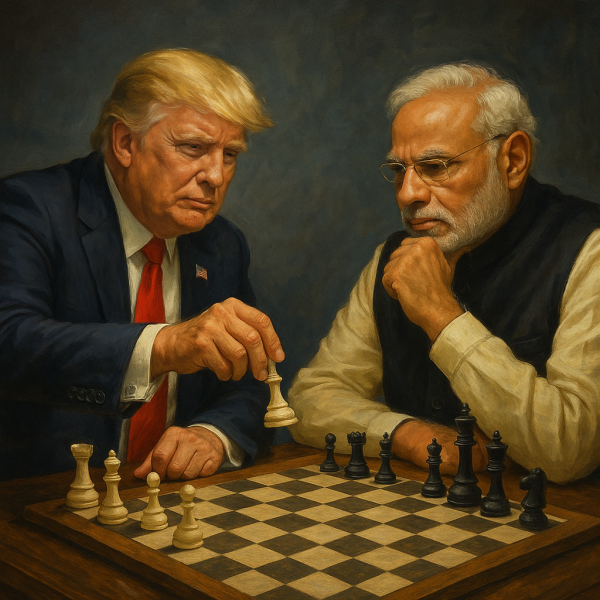
Trump is keen on destroying India economically, while Modi is providing India to him on a silver platter.
Tensions between the U.S. and India have escalated as trade negotiations continue. President Trump has repeatedly criticised India's tariff policies, calling India a "tariff king" and demanding changes to what he views as unfair trade practices. Meanwhile, Modi's government has been working to accommodate various U.S. demands through policy concessions.
Over recent months, Trump has systematically leveraged trade policies, technology regulations, defense sales, and diplomatic pressure in what appears to be a coordinated campaign to economically constrain India while strengthening its regional rivals.
Modi's government, meanwhile, largely gave in, offering Washington a series of remarkable concessions while receiving little in return.
Tesla Deal: Lower Taxes, No Factory

The dynamic was first visible in the high-stakes negotiations over electric vehicles. Tesla CEO Elon Musk previously expressed frustration with India's high import duties on foreign-made EVs, suggesting that a Tesla manufacturing facility in India hinged on more favorable import terms.
"Want to launch Tesla in India, but import duties are the highest in the world by far of any large country!" Musk posted on social media, adding that a factory would come "assuming Tesla will be able to succeed with imported vehicles first."
Modi's government responded by introducing a policy reducing EV import duties to 15% for companies investing at least $500 million in local manufacturing facilities. This dramatic policy turn undermines India's domestic automakers like Tata Motors and Mahindra, who had long benefited from high import barriers that protected their market position.
By opening the door to foreign competitors, the government has potentially weakened its own automotive industry just to court Tesla's favor.
Yet despite this significant policy shift tailored to Tesla's demands, Musk offered no firm commitment to build a factory. Instead, Tesla continues to maintain strong manufacturing presence in China.
The Tesla episode left Modi's government in an awkward position: having abandoned a key protectionist policy to attract American investment, only to see that investment directed toward China instead.
It was an early indication of what many observers now describe as an emerging pattern in Trump's approach to India:
“Demanding concessions while offering little in return, and sometimes actively undermining India's interests even after receiving what he asked for.”
India Welcomes Starlink After Years of Saying No
Meanwhile, Starlink, Elon Musk's satellite internet company, received regulatory approval to operate in India after previous hurdles. India has granted permissions following discussions between Musk and Prime Minister Modi, according to Foreign Policy reporting.
This approval comes after years of regulatory challenges that had previously prevented Starlink's entry into the Indian market.
These tech sector developments impact Modi's signature "Make in India" campaign. With U.S. companies reconsidering their manufacturing commitments in India, thousands of potential jobs and significant technology transfers hang in the balance.
Trade Wars: India Stuck Between US and China

Trump has aggressively pressured Modi to eliminate duties on American products while simultaneously demanding India raise tariffs on Chinese imports. This pressure campaign has included public statements calling India a "tariff king" and threats of reciprocal tariffs reaching 26% on Indian goods if changes aren't made.
Following months of this pressure, India has responded by lowering tariffs on U.S. machinery and biotech products, offering to reduce the overall tariff gap with America from 13% down to just 4%. At the same time, India has increased duties on certain Chinese chemicals and products, seemingly following Trump's anti-China playbook.
Yet while India makes these painful adjustments, Trump has quietly eased some trade tensions with China. Despite maintaining high headline tariffs of 125% on Chinese goods, certain exemptions and pauses have been implemented. This creates a troubling situation where India makes costly trade concessions thinking it's aligning with America's China strategy, only to discover Trump is simultaneously working out separate arrangements with Beijing.
The result leaves India in an awkward position: having damaged its trade relationship with China while receiving little benefit from America. Indian exporters and manufacturers are squeezed from both sides, as the country discovers it's merely a pawn in a larger game between economic superpowers.
“This two-faced approach leaves India paying the price while America and China pursue their own interests.”
Arms Pipeline: Ankara to Islamabad to Kashmir

Recent developments in weapons sales add another layer to the U.S.-India tensions. On May 14, 2025, the U.S. State Department approved a $304.1 million missile sale to Turkey, including 53 advanced AIM-120C-8 AMRAAM missiles worth $225 million and 60 AIM-9X Sidewinder Block II missiles valued at $79.1 million.
This approval comes at a particularly sensitive time for India. According to a March 2025 Stockholm International Peace Research Institute (SIPRI) report, Turkey directed 10% of its total arms exports between 2020 and 2024 to Pakistan, India's regional rival. These exports have included advanced drone systems like the Bayraktar TB2 and Akinci combat drones.
The timing of this arms sale has raised concerns in New Delhi, as it follows shortly after increased tensions between India and Pakistan. On April 22, 2025, a terrorist attack in Kashmir's Pahalgam region killed 26 tourists. When India conducted military operations in response to this attack in early May, reports indicate that Pakistan used Turkish-supplied equipment, including drones, against Indian forces.
Indian security analysts have expressed concern that advanced American weapons sold to Turkey may eventually make their way to Pakistan through the close defense partnership between Ankara and Islamabad. This pattern creates an indirect channel through which American military technology could ultimately be used against India.
During the recent India-Pakistan tensions, U.S. diplomatic responses raised questions about American support. While Secretary of State Marco Rubio communicated with officials from both countries urging restraint, Trump himself described the rising tensions merely as "a shame," according to Reuters reporting.
These developments come as India already faces pressure from China along its northern border, creating a complex security environment in which U.S. policy decisions carry significant implications for regional stability.
Apple's India Expansion Suddenly in Doubt

Apple's expansion plans in India have hit a roadblock with Trump's direct intervention. On May 15, 2025, during a business event in Qatar, President Trump publicly revealed he had told Apple CEO Tim Cook to stop building manufacturing facilities in India. "I don't want you building in India," Trump told Cook according to multiple reports, adding "We're not interested in you building in India, India can take care of themselves."
This confrontation comes at a critical moment for Apple's global strategy. According to Reuters reporting from April, Apple had been aiming to make most iPhones sold in the United States at factories in India by the end of 2026.
The company had already ramped up production significantly, with Apple shipping approximately 600 tons of India-made iPhones worth about $2 billion to the U.S. in March alone.
The timing of Trump's demand creates significant uncertainty for both Apple and India's manufacturing ambitions. Apple's suppliers have made substantial investments in India, with Foxconn committing $1.5 billion to expand operations and Tata Electronics acquiring a majority stake in Pegatron's iPhone plant in Tamil Nadu.
These facilities were expected to help India contribute 25-32% of global iPhone production within the next few years.
For Modi's "Make in India" initiative, Trump's intervention threatens to undermine a key success story. The iPhone manufacturing ecosystem in India currently employs tens of thousands of workers and represents billions in investment.
If Apple scales back these expansion plans due to pressure from the U.S. administration, it would not only impact jobs but also damage India's reputation as an alternative manufacturing hub to China.
The economic stakes are high for both sides. While Trump pushes for Apple to manufacture in America instead, analysts point out this would significantly increase production costs, potentially raising iPhone prices by as much as $1,000 per unit. Meanwhile, India risks losing a manufacturing relationship it has spent years cultivating through policy incentives and reforms.
$500,000 of Indian Mangoes Wasted in US

Even prized Indian mangoes couldn't escape the trade tension. In May 2025, U.S. authorities rejected 15 shipments of Indian mangoes at airports in Los Angeles, San Francisco, and Atlanta. The fruit, worth around $500,000, had to be destroyed after officials cited problems with paperwork related to the required irradiation process.
The timing raised eyebrows among exporters. The mangoes had been treated at a USDA-supervised facility in Mumbai on May 8-9, and the same U.S. officials who oversaw the treatment had approved the documentation. Yet when the shipments arrived in America, customs officials suddenly found fault with the PPQ203 forms.
For India, mangoes represent more than just trade: they're a symbol of the country's agricultural excellence and a source of pride. The U.S. market offers premium prices for varieties like Alphonso and Kesar that support entire farming communities.
Having these shipments rejected over what appears to be minor paperwork issues signals how even cultural products can become pawns in broader trade tensions.
India's Agricultural and Processed Food Products Export Development Authority (APEDA) has directed questions about the incident to the Maharashtra State Agricultural Marketing Board that operates the irradiation facility, but no clear explanation has emerged for why documentation approved in Mumbai was rejected upon arrival in the U.S.
Modi’s Silver Platter Strategy

Modi's pattern of giving in to Trump's demands has become increasingly apparent. Since Trump's return to office, India has offered a series of major concessions, including reportedly proposing a trade deal with "no tariffs" for American goods, slashing import duties on electric vehicles from 100% to 15%, and quickly approving Starlink's operations after years of regulatory hurdles.
The Prime Minister's approach has sparked criticism at home. Modi, described by analysts as a nationalist who has been criticised for India's democratic backsliding, has shown a willingness to lower tariffs on U.S. products and make other concessions to maintain his relationship with Trump. Modi and Trump’s rapport may be tested as Indian prime minister visits Washington. Opposition figures have questioned whether these one-sided concessions truly serve India's interests.
Meanwhile, Modi's government has framed these moves as strategic pragmatism. "The fact is that Trump is trying to change the global trading order. India recognizes this and now is looking for a pragmatic way to resolve the differences," said Raja Mohan, an analyst at the Institute of South Asian Studies in Singapore. Takeaways from Modi-Trump meeting: Cooperation on trade and defense, plus some mutual praise. Indian officials suggest that maintaining good relations with the U.S. is worth short-term sacrifices for long-term benefits.
Modi has been visibly eager to foster a personal connection with Trump, even adopting the American president's rhetoric. During their February meeting, Modi borrowed from Trump's "Make America Great Again" slogan to announce his own vision: "Make India Great Again," or "MIGA." Trump, Modi aim to cut U.S. trade gap with India amid global tariff concerns. He suggested that together, "MAGA plus MIGA" becomes "mega" – representing their partnership.
This strategy of fast concessions represents a calculated risk for Modi. India has continued ties with Russia during its war with Ukraine and remains a major consumer of Russian energy while the West has worked to reduce its consumption. India also faces challenges in managing its relationship with China. India, US agree to resolve trade and tariff rows after Trump-Modi talks.
By yielding to Trump on trade and technology issues, Modi hopes to maintain U.S. support on security matters, particularly regarding regional tensions with China and Pakistan.
Whether this approach will pay off remains uncertain. While Trump has paused implementing the 26% tariff on Indian goods, other demands continue to emerge, from blocking Apple's manufacturing expansion to rejecting agricultural exports over paperwork issues.
Regional and Global Reactions
Around the world, reactions to the U.S.-India tensions reveal complex strategic tactics. In Washington, Trump administration officials have praised Modi's willingness to negotiate, with Commerce Secretary Howard Lutnick declaring it's time for something "big" and "grand" in bilateral trade.
Yet behind closed doors, U.S. officials have made it clear they expect India to implement sweeping trade liberalisation, especially in agriculture. Areas that touch on politically sensitive sectors in India. Trump’s tariffs put India and its struggling economy at a crossroads.
Meanwhile, China watches these developments with strategic interest. As Trump signals potential warming of U.S.-China relations, India faces a dilemma. "India will likely have to recalibrate its stand in case of a Washington-Beijing thaw under Trump," notes Happymon Jacob, founder of the New Delhi-based Council for Strategic and Defense Research. Beijing perceives opportunity in any wedge between Washington and New Delhi, particularly as India struggles to maintain its strategic autonomy.
Pakistan has benefited from recent developments, especially Trump's insertion into regional affairs. When Trump announced he had brokered a ceasefire between India and Pakistan, he stated he would "increase trade, substantially, with both of these great nations."
This move exposed Modi to rare criticism at home, with opposition politicians demanding an explanation for "ceasefire announcements made from Washington, D.C." and questioning whether India had "opened the doors to third-party mediation." India's diplomatic ambitions tested as Trump pushes for deal on Kashmir.
European nations have been carefully monitoring these shifts. India has been advancing trade negotiations with the European Union, Australia, and Britain as a hedge against U.S. pressure. For Brussels, India represents both an opportunity for deeper economic ties and a potential counterweight to China in the Indo-Pacific. Trump’s tariffs put India and its struggling economy at a crossroads.
Trump's multi-pronged approach toward India raises serious questions about the future of this strategic relationship. Through tariff threats, technology restrictions, diplomatic interventions, and agricultural trade barriers, his administration has systematically pressured India from all sides.
What initially appeared as isolated incidents now forms a pattern that leaves India increasingly vulnerable on the global stage.
Looking ahead, the implications for both countries are significant. Even if India secures tactical gains through its concessions, "the strategic losses could be enduring," warn analysts.
While Modi's team has publicly touted potential benefits from Trump's disruptive approach, including possible access to previously restricted technologies, the costs to India's economic independence and strategic standing grow with each new concession. India Sees Opportunity in Trump’s Global Turbulence. That Could Backfire.
The most important question remains whether Modi's strategy of accommodation will ultimately strengthen or weaken India's position in the world. By accepting U.S. mediation in regional conflicts and making unreciprocated trade concessions, Modi risks undermining India's long-standing foreign policy positions while receiving limited benefits in return. India-Pakistan: Trump Could Corner Modi on Trade With Ceasefire.
As the 90-day tariff pause nears its end in July, the true price of Trump's friendship, and the wisdom of Modi's approach, will soon become clear.

What's Your Reaction?