



















India’s Counter to China's Growing Influence in South Asia

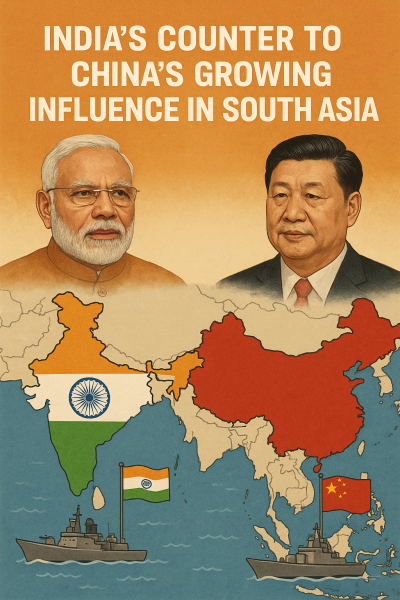
Across the Indian Ocean, India and China are fighting for control over South Asia. From Sri Lanka's ports to small island nations like the Maldives, both countries are competing to become the region's most powerful player. This fight goes beyond just military strength. It includes building roads and ports, making trade deals, and winning over governments.
India's leaders worry about China's "String of Pearls" strategy: a chain of naval bases and ports from China to Africa. This network includes ports in Pakistan's Gwadar, Sri Lanka's Hambantota and Colombo, Bangladesh's Chittagong, and China's military base in Djibouti. Reconnecting AsiaIndia
China's Belt and Road Initiative has changed the region completely. Five of India's six neighbours: Bangladesh, Maldives, Nepal, Pakistan, and Sri Lanka, now work with China on big infrastructure projects. Beijing has built ports and roads across these countries, which India sees as potential military threats. AsiapacificForeign Policy
India has fought back with its own strategy. New Delhi has built stronger ties with island nations like Seychelles, Mauritius, and the Maldives. India has also increased naval cooperation and made new partnerships across the Indo-Pacific region. GIS ReportsCarnegieendowment
The latest crisis with Bangladesh shows how serious this competition has become. After Bangladesh's leader called India's northeast states "landlocked" during a trip to China, India quickly closed border crossings and restricted trade, proving it will use economic pressure to counter Chinese influence. Business TodaySwarajyamag
The String of Pearls is Tightened

China's biggest project in the region is the China-Pakistan Economic Corridor (CPEC), worth over $62 billion by 2022. This massive network of roads, railways, and energy projects connects China's western regions to Pakistan's Gwadar Port on the Arabian Sea.
Originally valued at $46 billion, CPEC has become the main part of China's Belt and Road Initiative. Reconnecting AsiaWikipedia
Gwadar Port gives China direct access to the Indian Ocean and could serve as a naval base. Pakistan handed control of the port to a Chinese company for 43 years in 2013. The port can handle much larger ships after Chinese upgrades, and Pakistan created a special military force to protect it. CarnegieendowmentCsis
In Sri Lanka, China built the Hambantota Port and a $1.4 billion port city project in Colombo. When Sri Lanka couldn't pay its debts, it gave China a 99-year lease on Hambantota. China also controls a quarter of the new Colombo Port City through a Chinese company. Wilson CenterScmp
China's military base in Djibouti, opened in 2017, completes the western end of this network. In Myanmar, China is building the Kyaukphyu Deep Sea Port, just 65 miles from India's own Sittwe port project. Reconnecting AsiaIndia
China has also increased its presence in Bangladesh, Nepal, and the Maldives through infrastructure projects and loans. In Bangladesh, China is building power plants and working with political parties. In Nepal, Chinese companies are building hydropower projects near India's border. OrcasiaIndia
India Fights Back with Ships, Ports, and Partnerships

When Sri Lanka faced its worst economic crisis in 2022, India stepped in with about $4 billion in aid, including fuel, food, and medicines. This help came when China was reluctant to provide emergency support. India sent a warship carrying essential drugs and provided credit lines to keep Sri Lanka's economy running. ReutersForeign Policy
India's companies have won major contracts in Sri Lanka as the country turns away from China. Adani Green Energy got a $442 million deal to build wind power stations, while India's Adani Group won the contract for Colombo's West Container Terminal. Sri Lanka also gave India the contract to build an oil storage facility in Trincomalee and canceled a Chinese wind farm project after India objected. Nikkei AsiaForeign Policy
India has built coastal radar systems in partnership with Maldives, Mauritius, Sri Lanka, and Seychelles to watch maritime activities. India has also offered similar help to Myanmar and Bangladesh to improve their ability to monitor their waters. Through "Mission Sagar," India sent emergency medicines and food to Indian Ocean nations during the COVID pandemic. CarnegieendowmentGIS Reports
India's "Act East Policy" focuses on building stronger ties with Southeast Asian countries. India is helping upgrade Indonesia's Sabang island, less than 300 miles from the important Malacca Strait. India has access to Oman's Duqm port and is building defense partnerships with Indonesia, Singapore, Vietnam, and the Philippines, including selling BrahMos missiles to the Philippines. AsiapacificGIS Reports
The Quad alliance with the U.S., Australia, and Japan gives India a multilateral way to counter China. India has increased military exercises with these countries and expanded its naval presence across the Indo-Pacific. Despite having only 132 warships compared to China's 370, India is focusing on strategic partnerships to balance Chinese power. GIS ReportsScmp
The Bangladesh Crisis: Trade Fight as Warning Shot

The biggest test of India's strategy came when Bangladesh's interim leader Muhammad Yunus made shocking comments during his visit to China in March 2025. Yunus said India's northeastern states were "landlocked" and called Bangladesh the "only guardian of the ocean for all this region." He invited China to use Bangladesh as a gateway, saying the region "could become an extension of the Chinese economy." SwarajyamagBusiness Today
India hit back fast and hard. New Delhi imposed port restrictions on Bangladeshi goods, forcing exporters to use only two expensive seaports instead of cheaper land routes. India also withdrew the transit facility that allowed Bangladesh to export goods through Indian ports to other countries. Previously, 93% of Bangladesh's exports to India moved through land ports in India's northeast. ANI NewsThe Tribune
The restrictions hurt Bangladesh badly. The country exports about $740 million worth of garments to India annually, and total trade between the two countries was worth $12.9 billion in 2023-24. Bangladesh now faces much higher shipping costs and delays, especially for its important textile industry that competes directly with India. Jagonews24News9live
China quickly stepped in to support Bangladesh. During Yunus's China visit, Beijing promised $2.1 billion in investments and cooperation agreements. Chinese officials have been meeting with Bangladesh's political parties, including the opposition Bangladesh Nationalist Party, which has traditionally taken anti-India positions. Jagonews24Orfonline
Bangladesh has become a testing ground for the India-China competition. China sees Bangladesh as important for its Belt and Road Initiative and wants to prevent any U.S. influence there. Meanwhile, India worries that a pro-China Bangladesh could threaten its northeastern states' security and economic development. IndiaOrfonline
Nepal and Myanmar: Small Countries Caught in the Middle

Nepal, stuck between two nuclear powers, has chosen to play both sides. The country takes money from China's Belt and Road Initiative for roads and power projects while maintaining close ties with India. Nepal supports China's "One China" policy but also hosts Tibetan refugees, which worries Beijing about possible anti-China activities. SpringerLinkAsia Society
China has been building infrastructure projects near India's sensitive border areas in Nepal. Chinese companies are working on hydropower projects and roads close to the Indian border. This worries India because these projects could give China more influence over a country that India considers part of its natural sphere of influence. OrcasiaAsia Society
In Myanmar, both India and China are competing for influence through port projects. China is building the massive Kyaukphyu Deep Sea Port in Rakhine State, just 65 miles from India's Sittwe port project. China's port will be much larger and could overshadow India's investment in the same region. OrcasiaAsiapacific
India fears that Chinese military presence near its northeastern borders through Nepal and Myanmar could threaten its security. The northeast region borders both countries and has faced problems with insurgent groups. Any Chinese influence over transport routes or military facilities in these areas could create serious security challenges for India. OrcasiaWikipedia
China is particularly sensitive about Tibet-related activities in Nepal. Beijing worries that India's support for Tibetan refugees and the Dalai Lama could spread anti-China movements through Nepal into Tibet. This makes China determined to limit Indian influence in Nepal and build stronger ties with Nepalese political parties. Nepal’s Geopolitical Crossroads: Balancing China, India, and the United States | Asia Society
The Big Picture: Unequal Fight

India faces a tough challenge because China's economy is more than five times larger than India's. This means Beijing can offer much bigger loans and infrastructure deals to South Asian countries. While India provides aid and partnerships, China can promise billions of dollars in immediate investments. India Is Pushing Back Against China in South Asia
China also has a much stronger navy. Beijing operates 370 warships compared to India's 132, and this number is expected to grow to 435 by 2030. China's new nuclear submarines are extremely hard to detect, giving Beijing a major advantage in controlling sea routes. India’s Competition with China for Dominance of the Indian Ocean
Both countries use different approaches to win friends. India promotes democratic values and offers partnership-based cooperation. China focuses on fast development financing and doesn't ask questions about governance or human rights. Many smaller countries find China's no-strings-attached money more attractive than India's slower, condition-based help. BrookingsForeign Policy
South Asian countries have learned to play both sides. They adopt what experts call "hedging" strategies, trying to get benefits from both India and China while avoiding taking sides completely. This allows them to maximize economic gains while maintaining some independence. How does the India-China rivalry affect secondary state behaviour in South Asia?
What's Next: The Score So Far

India has made important gains recently, especially in Sri Lanka and the Maldives, but China's long-term investments across the region remain strong. The competition will likely intensify as both countries expand their naval capabilities and economic outreach. Success will depend on India's ability to maintain partnerships while avoiding overextension in a region where China holds significant economic advantages. Foreign Policy
What's Your Reaction?