


















Arunachal’s Breaking Point: The Siang Dam Protest

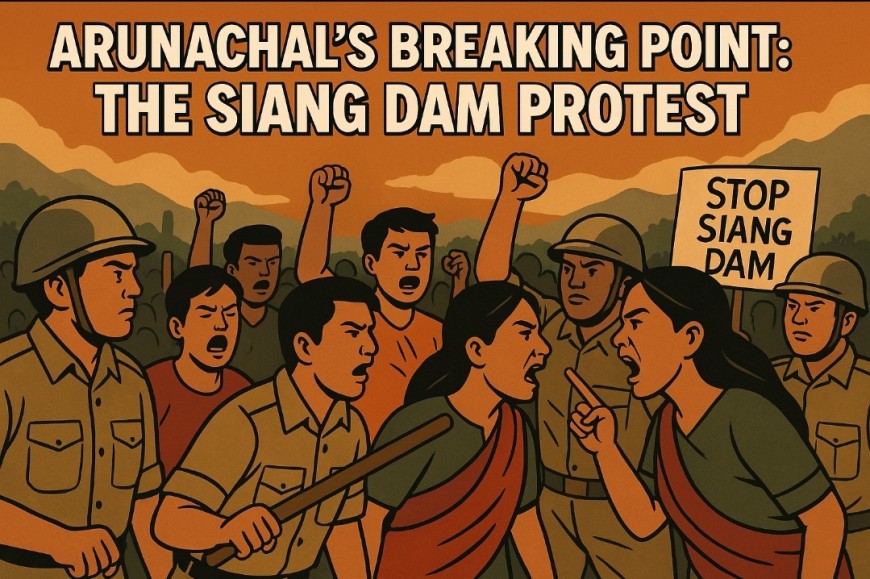
On May 27, 2025, what began as a routine fact-finding visit by Rural Development and Panchayati Raj Minister Ojing Tasing to Boleng in Siang district exploded into chaos. A gathering meant to address local apprehensions over the 11,500 MW Siang Upper Multipurpose Project (SUMP) swiftly devolved into a violent clash between villagers and security personnel.
In the melee, a video clip surfaced showing Tasing allegedly elbowing a female protester, instantly igniting outrage across Arunachal Pradesh’s social feeds. As hashtags condemning the minister trended, a deeper question emerged: Is the state prepared to hear dissent, or is it prepared to suppress it? Northeast Live
Within hours, footage of the scuffle flooded Facebook groups and WhatsApp forwards. One widely shared post on the “Voice of Arunachal Pradesh” page claims to capture the moment Tasing strikes out at a woman standing at the front line of the gherao.
Activist circles, student unions, and regional influencers amplified the clip, decrying it as emblematic of the government’s hardening stance against local voices. Despite the uproar, no formal First Information Report (FIR) has been filed, only terse denials from ministerial aides. Facebook
Minister’s Denial and Counterclaim

From his party headquarters in Itanagar, Minister Tasing has flatly rejected the assault allegations as a “concocted” smear. He insists the viral video has been selectively edited to misrepresent his actions. According to his version, he and his elderly uncle were the real victims, pelted with chili powder and besieged by youths intent on “gheraoing” him into surrender.
Speaking to a local news channel: Tasing recounts dodging fists as he was escorted away under a security cordon, asserting he never laid a hand on any woman. He also clarified that he was attacked twice on his way. One of the women even brought a knife and he was only defending himself at the time when his elbow struck the woman shown in the video. Northeast Live

The flashpoint is the 11,000 MW Siang Upper Multipurpose Project (SUMP), a joint NHPC–NEEPCO initiative slated to harness the Siang River for power generation, irrigation, and flood control. The state touts it as “a project of national importance,” promising year-round river flow and protection against downstream flooding from upstream releases by China Insights IAS.
But for many Adi villagers, the SUMP reads less like progress and more like eviction. They warn that the reservoir, designed to hold nine billion cubic metres, will submerge ancestral lands across Parong, Dite Dime, and Uggeng, uprooting some 150,000 people and erasing millennia-old cultural sites SANDRP. Trust shattered, locals recall government assurances that “no dam will be built without consent.” That pledge now sounds like a hollow promise, fueling the sense of betrayal that ignited Boleng’s unrest.
Government’s Silence and Spin

In the aftermath of the videos, the state has leaned into spin over substance. Deputy Chief Minister Chowna Mein publicly urged calm and vowed “open-mind[ed] talks” with village chiefs and student leaders, framing dialogue as the cure for unrest Northeast Live. Yet there has been no formal apology to the woman in the clip, no FIR, and no inquiry into the minister’s conduct.
Instead, the administration continues to fast-track the NHPC-backed survey work, even as Central Armed Police Forces remain deployed to ensure smooth progress. The unspoken message: economic and strategic priorities trump community consent.
Siang is Not Just a River: It’s a Lifeline
For the Adi tribe, the Siang is more than water and rocks: it is “Ane Siang,” Mother Siang, the source of life and lore. Along its banks lie sacred groves, burial grounds, and spiritual shrines passed down through generations. As SIFF president Gegong Jijong warns, once submerged, these sites, and the very Adi identity, cannot be reclaimed SANDRP.
This is why the protest is not merely an anti-dam demonstration but a fight to protect culture itself. In Boleng, the anger is rooted in the fear that development, as currently pursued, means cultural erasure rather than empowerment.
Anxious Northeast, Angry India

What began in Boleng has rippled across the region. In Guwahati and Shillong, student bodies such as the Adi Students’ Union and the Siang Indigenous Farmers’ Forum (SIFF) have echoed Boleng’s cry, staging solidarity dharnas at state capitals and demanding an end to “state-backed intimidation” Maktoob media.
On X and Instagram, #ProtectSiang and #VoicesNotVictims have trended nationwide, amplifying villagers’ fears from a remote valley to urban living rooms. Slowly, national outlets are shifting focus. Delhi desks can no longer ignore a protest that now unites Assam, Meghalaya, and Arunachal under a single banner of dissent.
An elected minister accused of assaulting a peaceful demonstrator represents more than a local scandal: it’s a democratic crisis. Here, a people’s movement met not with inquiry but with derision and denial, as video evidence collides with official spin Northeast Live.
Development, when pursued without accountability, risks silencing the very citizens it claims to empower. If viral clips cannot compel an investigation, what recourse remains for those who stand up, and stand up first, against power?
A Test for the State, a Warning for the Nation
Arunachal Pradesh faces a stark choice: heed its people or crush their voices. The legitimacy of Minister Tasing’s cabinet role now hangs in the balance. Will the government summon the courage to investigate, apologize, and rebuild trust, or will it double down, risking further fracture?
From Boleng’s banks to Delhi’s corridors of power, the world is watching, and so is Northeast India. The answer will define not just a dam’s future, but the health of Indian democracy itself.
What's Your Reaction?