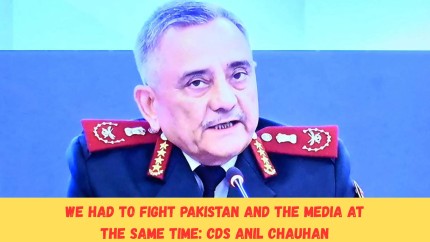




















We had to Fight Pakistan and Media at the Same Time: CDS Anil Chauhan

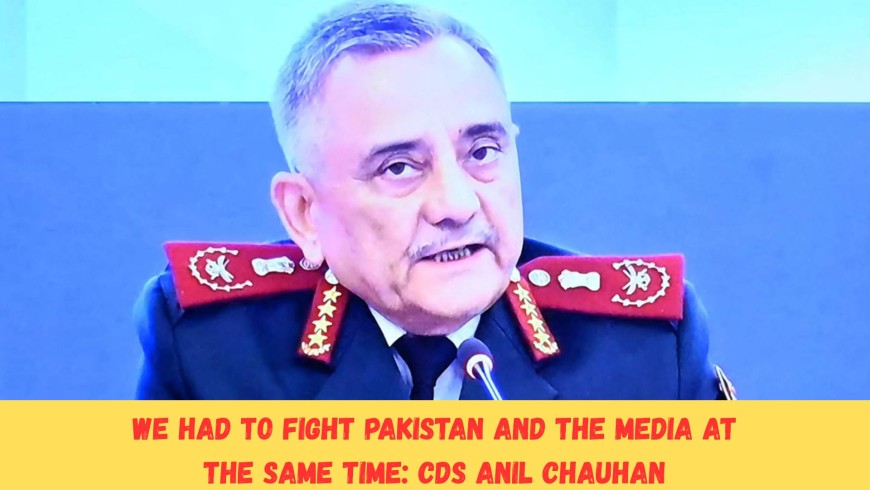
This not so unusual statement was given by India’s Chief of Defense Staff at the Shangri-La Dialogue in Singapore on May 31, 2025.
World leaders, military chiefs, and defense analysts had gathered to discuss regional stability in Asia, but it was India’s Chief of Defence Staff, General Anil Chauhan, who drew particular attention when he sat down with Bloomberg TV. The discussion was not a routine press engagement; it came on the heels of Operation Sindoor, India’s rapid and forceful response to the Pahalgam terror attack of April 22nd, in which 26 civilians lost their lives.
Though tensions along the border had simmered for months, the Pahalgam assault propelled New Delhi to act swiftly, and the subsequent aerial strikes against militant camps in Pakistan marked a significant escalation. Against this backdrop, General Chauhan’s candid reflections in Singapore provided rare insight into how India’s military had weathered its own missteps before regaining momentum.
Launched in direct response to the Pahalgam terror attack, the operation marked one of the most rapid escalations between India and Pakistan in recent years. The strikes were surgical and sustained, targeting militant infrastructure and signaling a shift in India’s posture. But as General Chauhan revealed, the campaign was far from frictionless. From the outset, the Indian military had to contend not only with the enemy’s air defenses but also with a flood of misinformation.
“Fifteen percent of the Army's time during Operation Sindoor went into countering fake narratives by the Media,” Chauhan said, pointing to a coordinated online effort that sought to distort facts, confuse the public, and undercut support for the campaign.
And the challenges weren’t limited to social media warfare. In a moment of striking honesty, Chauhan acknowledged that India had lost fighter jets early in the operation. He didn’t specify how many, but he was clear that the issue wasn’t about numbers, it was about missteps.
“What is important is not the jet being down, but why they were being downed,” he said, signaling a rare willingness to confront failure head-on. The general emphasised that within 48 hours of the initial setback, Indian forces had reviewed their approach, identified the flaws in tactics, and adapted. “We were able to understand the tactical mistake which we made, remedy it, rectify it, and then implement it again after two days and flew our jets again, targeting at long range,” he explained.
Those adjustments proved decisive. Initially, Indian jets had targeted areas close to the border: locations within quick reach but also heavily defended by Pakistani surface-to-air systems and shoulder-fired missiles.
The results were costly. In the revised playbook, Indian planners opted for deeper strikes, hitting airbases and logistical hubs further inside Pakistani territory. This not only minimised exposure to front-line defenses but also allowed the Indian Air Force to target more valuable infrastructure, including runways and hangars used to launch attacks.
At every step, Chauhan said, Indian decision-makers remained acutely aware of Pakistan’s nuclear red lines and took pains to avoid triggering them.
“Once we changed our target roster, we were able to punch holes in their deeper defenses without risking an all-out escalation,” he said. It was a calculated escalation, one meant to demonstrate capability without crossing a line.
But even as the jets flew and operations proceeded, the battle for perception was just as fierce. With misinformation campaigns circulating online, Indian forces found themselves navigating a war on two fronts: one in the sky, and one in the feed.
In Summary:
General Chauhan’s openness about setbacks marks a rare moment of transparency in India’s military leadership. By acknowledging mistakes and detailing how they were swiftly addressed, he signaled a shift toward accountability and adaptive strategy.
This candor may not only bolster public trust but also influence future defense planning… prioritising flexibility, information warfare preparedness, and a willingness to learn in real time, even during conflict.
What's Your Reaction?