


















Terror in Plain Sight: How Maharashtra & Karnataka Became Danger Zones for Hindi Speakers

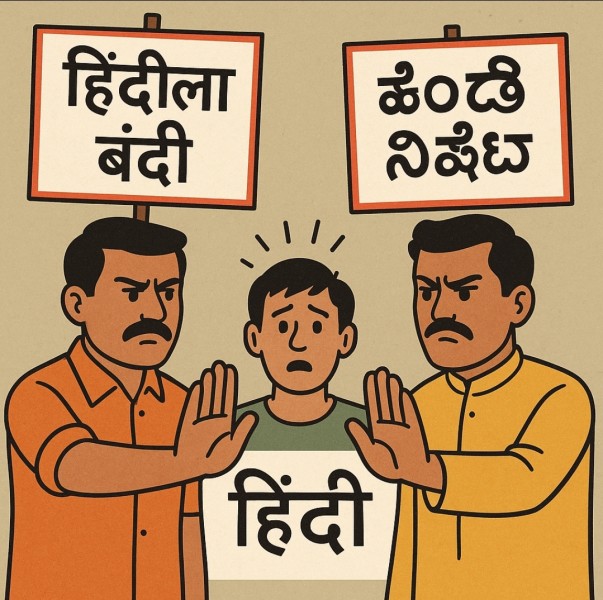
In March 2025, a shocking video emerged from Mumbai’s Versova area that should alarm every Indian who believes in our nation's founding principles. A D-Mart supermarket employee was physically slapped and humiliated by Maharashtra Navnirman Sena (MNS) workers after he told a customer “I will not speak in Marathi, I will speak only in Hindi.” ThePrintFree Press Journal
Just weeks earlier in Bengaluru, an auto driver named Mutturaj slapped and abused a woman passenger, telling her to “speak in Kannada” when she asked in Hindi whether cancelling a ride was a crime Prokerala
These assaults, captured on camera and broadcast across social media, represent far more than an isolated incident of violence: it symbolises a dangerous erosion of India’s constitutional promise of diversity and unity.
But these incidents were merely the tip of the iceberg. MNS workers have expanded their targets beyond retail employees to include bank staff, with incidents reported where banking personnel faced intimidation and threats for conducting business in Hindi MNS Worker Allegedly Slaps D-Mart Staff In Mumbai For Not Speaking Marathi; Sanjay Nirupam Criticizes Raj Thackeray's Party for the Incident - www.lokmattimes.com.
More alarmingly, this organised violence has now inspired copycat attacks by ordinary citizens. What began as political thuggery by MNS cadres has grown into a broader social phenomenon where average Marathis feel pride in attacking Hindi speakers, believing they are doing all this for the greater good of their state. Considering themselves nothing short of modern day ‘Shivaji Maharaj.’
The violence has spread to food service workers, security guards, and small business owners. Anyone whose livelihood depends on serving the public but who dares to communicate in Hindi Mumbai: MNS Workers Brutally Beat Hotel Employee Allegedly For Abusing Marathi Family In Mulund (VIDEO).
The systematic nature of these attacks reveals a coordinated campaign designed to make Hindi speakers feel unwelcome and unsafe in Maharashtra.
Meanwhile in Karnataka, systematic discrimination has become routine, with auto drivers charging ₹300 to Hindi speakers while offering the same ride for ₹200 to Kannada speakers, and some drivers completely ignoring Hindi-speaking passengers Bengaluru Auto Drivers Overcharges Hindi-Speaking Woman, Video Sparks Outrage | Republic World.
For seven decades, India has prided itself on being a nation where multiple languages coexist, where Article 29 of our Constitution guarantees every citizen the right to conserve their distinct language and culture.
Yet today, in Maharashtra and Karnataka, this foundational principle faces an unprecedented assault. These two states have transformed into hotbeds of language-based violence, where speaking Hindi has become grounds for physical attack, economic discrimination, and systematic harassment.
The crisis extends beyond individual incidents of violence. It represents a fundamental breakdown of governance, where state governments either actively encourage linguistic chauvinism or remain criminally passive as their citizens face persecution for their language choices.
This government inaction has given power to the extremist groups and radicalised ordinary citizens to launch what can only be described as a terror campaign against Hindi speakers, threatening the very fabric of our diverse democracy.
What makes this linguistic terrorism particularly insidious is how it has normalised violence in the minds of ordinary citizens. Shopkeepers now feel justified in humiliating customers, while bystanders watch approvingly as Hindi speakers are publicly shamed and physically assaulted MNS workers slap shopkeeper after he asks woman to speak to him in Marwadi instead of Marathi- The Week.
The MNS in Maharashtra and pro-Kannada groups in Karnataka have successfully created an atmosphere where linguistic violence is not just tolerated but celebrated as an act of cultural protection.
Maharashtra's MNS Terror Campaign Against Hindi Speakers

The MNS has systematically escalated its campaign of violence against Hindi speakers, with 2025 marking a particularly brutal period of attacks. In the D-Mart Versova incident, MNS workers led by their unit president Sandesh Desai stormed the supermarket, confronted the employee, and physically assaulted him while demanding to know when he came to Mumbai. The workers then forced him to learn Marathi if he wanted to continue working 'Nahi Aata Marathi, Jo Karna Hai Kar': D-Mart Store Employee Sparks Language Dispute In Mumbai's Versova, Gets 'MNS Style' Lesson; Video Viral.
Just weeks later in April 2025, the violence escalated further. A security guard at L&T in Powai was surrounded by MNS members and slapped after allegedly saying "Marathi gaya tel lagane" (Marathi can go to hell). The confrontation, captured on video, shows the guard from North India being forced to apologize with folded hands while MNS workers demanded he "lower his arrogance" and learn Marathi India TV NewsLokmat Times.
The pattern of targeting vulnerable workers continued in January 2025. MNS workers brutally beat a fast food stall employee in Mulund, grabbing him by the collar, slapping him repeatedly, and dragging him out of the stall. When another employee tried to intervene, he too was slapped and warned to stay away Mumbai: MNS Workers Brutally Beat Hotel Employee Allegedly For Abusing Marathi Family In Mulund (VIDEO).
The attack followed an altercation with a Marathi family who approached the MNS office for "justice."
Even established business owners aren't safe from this reign of terror. In December 2024, MNS activists slapped and humiliated a shopkeeper in Girgaon after he asked a Marathi-speaking woman to communicate in Marwadi instead of Marathi. The shopkeeper was dragged to the MNS office, physically assaulted, and forced to publicly apologize MNS workers slap shopkeeper after he asks woman to speak to him in Marwadi instead of Marathi- The Week.
MNS's Justification of Violence
What makes these attacks particularly chilling is the MNS leadership's open justification of violence as a legitimate political tool. Party spokesperson Vageesh Saraswat brazenly admitted: "Marathi is the language of Mumbai and the rest of Maharashtra. But some people deliberately disrespect and humiliate the language.
While teaching such elements a lesson, violence does take place. But it is not intentional" MNS Worker Allegedly Slaps D-Mart Staff In Mumbai For Not Speaking Marathi; Sanjay Nirupam Criticizes Raj Thackeray's Party for the Incident - www.lokmattimes.com.
This Orwellian doublespeak, claiming violence is both justified and unintentional, reveals an organization that has abandoned democratic norms entirely.
The MNS has developed a calculated strategy of targeting working-class Hindi speakers who lack the resources to fight back legally or flee to safer locations. Auto drivers, shopkeepers, security guards, and food service workers: people simply trying to earn an honest living, have become the primary victims of this linguistic terrorism.
The organisation deliberately chooses vulnerable targets who cannot afford legal representation or media attention, ensuring their campaign of intimidation continues with minimal consequences.
Legal Consequences and Government Response
The systematic nature of MNS violence has finally prompted legal action. A petition filed in the Supreme Court by Sunil Shukla of the Uttar Bharatiya Vikas Sena seeks action against MNS and Raj Thackeray for "public calls to violence and actual physical assaults on Hindi speaking persons at multiple locations in Mumbai."
The petition reveals that the petitioner himself received over 100 anonymous death threats, while 30 MNS-affiliated persons attempted to ransack his party office Plea in Supreme Court seeks action against Raj Thackeray, de-recognition of MNS for violence against Hindi speakers.
Yet the Maharashtra government's response has been characterised by criminal negligence. Despite video evidence of multiple assaults, documented threats, and Supreme Court petitions, state authorities have failed to take decisive action against MNS leadership.
This inaction sends a clear message: in Maharashtra, violence against Hindi speakers will be tolerated, if not tacitly encouraged.
Karnataka's Auto-Rickshaw Reign of Terror

Karnataka has witnessed the emergence of what can only be described as an auto-rickshaw mafia that terrorises Hindi speakers with impunity.
In September 2024, auto driver Mutturaj exemplified this menace when he slapped and abused a woman passenger after she cancelled her Ola ride. When the victim asked in Hindi whether cancelling a ride was a crime, he used vulgar language and demanded she "speak in Kannada," declaring "Let anything happen today; I am not going to be quiet" ProkeralaThe News Minute.
The driver's brazen confidence was evident when he told the victim to "lodge a police complaint" after assaulting her, showing complete contempt for law enforcement Bengaluru News: Watch | Bengaluru auto driver 'harasses' woman passenger for cancelling ride, held.
The discrimination has become institutionalised through systematic pricing manipulation. A viral investigation revealed the shocking extent of this linguistic apartheid: auto drivers routinely charge ₹300 for rides to Indiranagar when approached by Hindi speakers, but immediately reduce the fare to ₹200 when the same destination is requested in Kannada.
Some drivers go further, completely ignoring Hindi-speaking passengers while readily agreeing to ferry Kannada speakers to identical locations Bengaluru Auto Drivers Overcharges Hindi-Speaking Woman, Video Sparks Outrage | Republic World.
The harassment extends beyond fare manipulation to outright intimidation by state authorities.
Entrepreneur Vatsal Sanghvi documented a chilling encounter where Bengaluru police subjected him and his friend to "unwarranted harassment" at 10:30 PM, with the officer's demeanour changing only after his friend responded in Kannada Kannada Language Row: Entrepreneur Accuses Bengaluru Police Of Harassment | India News | Zee News. This incident reveals how Karnataka's law enforcement apparatus has been weaponised against Hindi speakers.
The scale of this organised harassment is staggering. Bengaluru traffic police registered 6,137 cases against auto drivers in just nine months of 2024, with an average of 20-25 complaints reported daily. Between January and July 2024 alone, police recorded 2,586 cases of drivers refusing rides and 2,582 complaints about inflated fares News KarnatakaNews9live, yet the persecution continues unabated.
Institutional Discrimination
Karnataka's linguistic terrorism extends far beyond auto-rickshaws into systematic institutional discrimination.
A 52-year-old tent rental company owner from Tumakuru was physically assaulted by his own staff after he asked them to learn Kannada when they couldn't understand the word 'deepada kamba' (lampstand) ThePrintNews Karnataka.
This incident demonstrates how the state's anti-Hindi hysteria has poisoned workplace relationships and emboldened employees to attack their employers.
The banking sector has become another battlefield for linguistic persecution. An SBI branch manager in Anekal taluk was transferred after refusing to speak Kannada, with the incident sparking political outcry when she insisted on using Hindi during customer interactions Karnataka SBI staffer transferred after video refusing to speak Kannada goes viral, CM Siddaramaiah reacts | Karnataka News – India TV.
The Karnataka Development Authority issued an ultimatum to all nationalized and rural bank employees: learn Kannada within six months or leave their jobs, effectively holding livelihoods hostage to linguistic conformity Learn Kannada language or leave: Karnataka government body issues warning to bank staff - Learn Kannada language or leave: Karnataka government body issues warning to bank staff BusinessToday.
Government Encouragement
Rather than protecting all citizens equally, Karnataka's government has actively encouraged this linguistic chauvinism. Chief Minister Siddaramaiah openly declared: "All the people living here are Kannadigas. No matter what your language at home is, the business language should be in Kannada" Karnataka language militancy a sign of losing dominance—Tamil, English, now Hindi rule streets, essentially erasing the linguistic rights of millions of non-Kannada speakers.
This official endorsement of linguistic supremacy has given free authority to extremists and transformed state machinery into an instrument of persecution against Hindi speakers.
Central Government’s Silence
The Union government's deafening silence in the face of these constitutional violations represents a catastrophic failure of federal responsibility. Despite clear evidence of systematic discrimination against Hindi speakers: a community the Central government claims to champion.
New Delhi has failed to invoke Article 355, which mandates the Centre to protect states against internal disturbance. The government that speaks endlessly about Hindi promotion abroad remains mute when Hindi speakers face physical assault at home.
This federal abdication has emboldened regional extremists to escalate their campaigns, secure in the knowledge that no consequences will follow. When citizens are forced to approach the Supreme Court for protection from state-sponsored linguistic persecution, it signals a complete breakdown of governance Plea in Supreme Court seeks action against Raj Thackeray, de-recognition of MNS for violence against Hindi speakers.
The Centre's failure to even consider President's Rule in the face of such systematic violation of fundamental rights represents either cowardice or complicity.
The Broader Threat to National Unity
The linguistic violence in Maharashtra and Karnataka threatens far more than individual victims. It strikes at the foundational principles of Indian federalism. When states can systematically persecute citizens based on language with impunity, it destroys the basic premise that Indians can live and work anywhere in their own country.
This balkanization creates a dangerous precedent where linguistic identity becomes more important than national citizenship.
The economic consequences are already devastating. With over 6,000 harassment cases registered against auto drivers alone in Karnataka, the state is rapidly gaining a reputation as hostile to outsiders Bengaluru Police Intensify Crackdown on Auto Driver Harassment Cases.
Businesses are quietly relocating operations, skilled professionals are avoiding job opportunities, and investors are questioning the stability of states where linguistic mobs dictate policy. The brain drain from these regions will ultimately impoverish their own economies while enriching more welcoming destinations.
Globally, successful multilingual societies from Switzerland to Singapore thrive precisely because they protect linguistic minorities rather than persecute them. These models demonstrate that economic prosperity and cultural diversity are mutually reinforcing. Yet Maharashtra and Karnataka have chosen the path of linguistic apartheid, ensuring their gradual economic and social decline.
Most alarmingly, other states are beginning to emulate this toxic model. If Tamil Nadu, Bengal, or Telangana adopt similar policies toward Hindi speakers, India will fragment into linguistic fortresses, destroying the mobility and unity that have been our strength since independence.
Solutions For this Grave Problem
India stands at a crossroads. We can either arrest this slide toward linguistic fascism or watch our nation splinter into hostile linguistic territories. The solution requires immediate, decisive action across multiple fronts:
The Union government must immediately invoke Article 355 and deploy central forces to arrest MNS leadership and their Karnataka counterparts.
Organisations that openly advocate and practice violence against citizens based on language must be banned under anti-terror legislation Plea in Supreme Court seeks action against Raj Thackeray, de-recognition of MNS for violence against Hindi speakers. The same vigor applied to other forms of extremism must be directed against linguistic terrorism.
Economic sanctions must target businesses and institutions that practice linguistic discrimination. Companies allowing language-based harassment should face GST audits, labor law investigations, and exclusion from government contracts. Auto drivers who charge discriminatory fares based on language must lose their licenses permanently Bengaluru Auto Drivers Overcharges Hindi-Speaking Woman, Video Sparks Outrage | Republic World.
Educational intervention is crucial. Schools in Maharashtra and Karnataka must implement mandatory programs celebrating India's linguistic diversity, teaching children that multilingualism is strength, not threat.
Media campaigns must counter the poison spread by linguistic extremists with stories of successful multilingual Indians.
Most importantly, India's silent majority must reject the politics of linguistic hatred. Every citizen who believes in our constitutional values must speak out against these attacks, support victims, and vote out politicians who enable linguistic terrorism.
The restoration of India's inclusive ethos depends not just on government action, but on ordinary Indians choosing unity over division, harmony over hatred.
The Northeast Example: Unity in Diversity

While Maharashtra and Karnataka tear at India's linguistic fabric, the Northeast stands as a shining example of how true unity in diversity should function. This region, home to dozens of indigenous languages: from Assamese and Bengali to Mizo, Naga dialects, Manipuri, and Bodo, has achieved something that seems impossible in western and southern India: peaceful multilingual coexistence.
States like Assam, with its rich Assamese heritage, Manipur with Meitei as its primary language, and Nagaland with over a dozen tribal languages, have embraced Hindi as a practical link language without abandoning their cultural identities.
Unlike the zero-sum mentality in Maharashtra and Karnataka, Northeastern states recognize that learning Hindi enhances rather than threatens local languages. A student in Shillong can speak Khasi at home, learn in English at school, communicate with fellow Indians in Hindi, and feel proud of all three linguistic abilities.
The Northeast's educational policies exemplify this inclusive approach. Schools routinely teach local languages, English for global connectivity, and Hindi for national integration: creating truly multilingual citizens rather than linguistic warriors.
Universities in Guwahati or Imphal conduct research in local languages while participating in national academic discourse in Hindi and English.
This stands in stark contrast to Maharashtra and Karnataka's divisive approach, where linguistic diversity is weaponized for political gain. While Northeastern states celebrate their languages as contributions to India's cultural mosaic, Maharashtra and Karnataka have chosen the path of linguistic fascism, treating Hindi speakers as invaders rather than fellow Indians.
The Northeast proves that protecting local languages and embracing national unity are not contradictory goals: they are complementary aspects of a mature democracy.
What's Your Reaction?