


















IIT Kanpur conducts successful test flight for cloud seeding experiment.

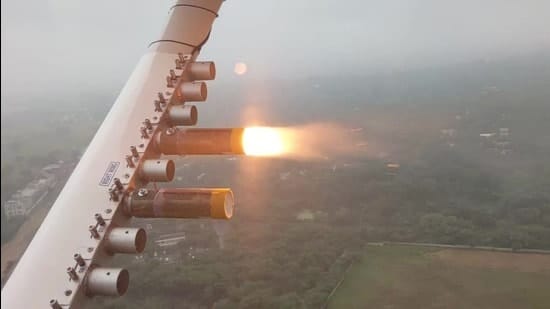
The Indian Institute of Technology, Kanpur (IIT, Kanpur) on Wednesday conducted a successful test flight for cloud seeding experiment.
Reportedly, the project was initiated a few years ago at IIT Kanpur and is led by Professor Manindra Agarwal of the Department of Computer Science and Engineering.
Professor of the Computer Science and Engineering Department of IIT Kanpur, Manindra Agrawal in a statement said, “A unique experiment was done at IIT Kanpur. A test flight for cloud seeding was successfully conducted. A Cessna aircraft was flown with cloud-seeding attachments procured from a manufacturer in the US. The test flight spread the agents using a flare as is standard practice.”
“It didn't rain as we did not fire the flares into the clouds, it was a trial for the equipment. But the successful test flight implies that we’re now prepared to run a cloud seeding in later stages. The experiment was conducted with due approval from the DGCA. We have been working on this project for a few years now,” he added.
The Professor said it was delayed earlier due to the various reasons, the last being the Covid 19 pandemic and stated that, "now, after the approval from DGCA and successful completion of the first trial, we are close to completing the setup."
According to a release, the test flight went up to an approximate height of 5000 feet.
"The short flight took off and came back to the IIT Kanpur Flight Lab airstrip, after successfully completing the test ride," the release further stated.
What is Cloud Seeding?
Cloud Seeding which is usually done through aircrafts equipped with essential tools is a scientific process or an artificial way to improve the quality of the clouds to rain or to snow.
Cloud seeding is the process of sprinkling various chemical agents into the clouds such as silver iodide crystals, dry ice, common salt and other elements in an attempt to make rain especially in a place where there is lack of rain.
(With inputs from agencies)
What's Your Reaction?