




















Astronomers detect strong radio signals from an Earth size exoplanet hinting the existence of life.

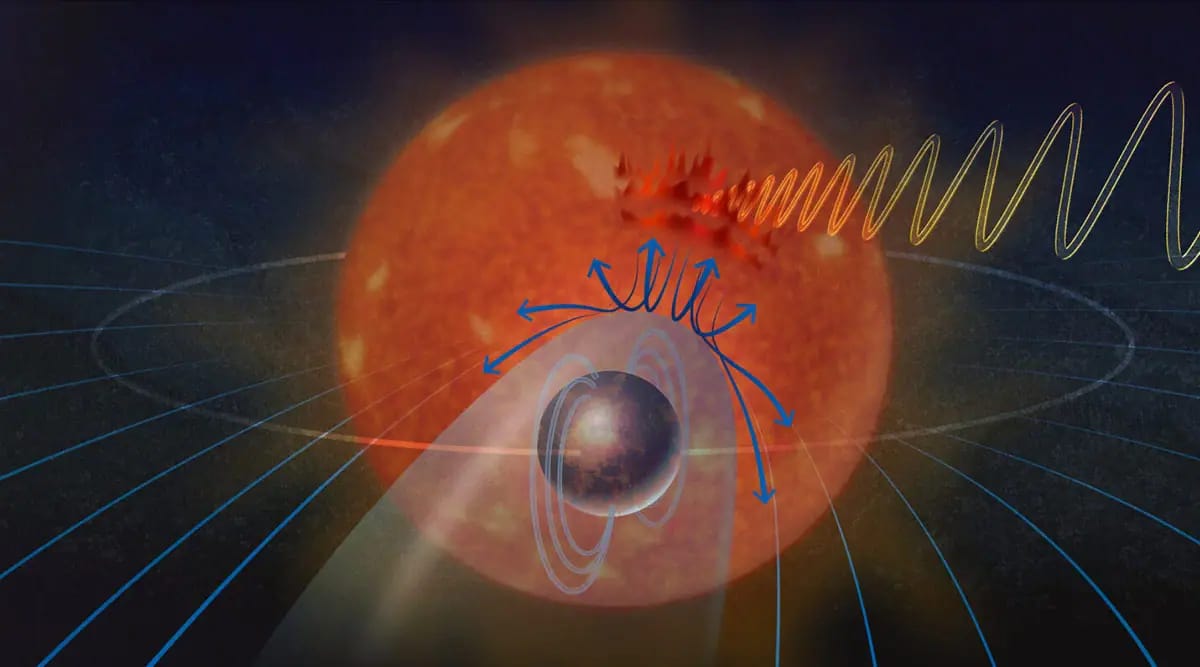
As per reports by CNN, astronomers have detected a repeating radio signal from an earth-size exoplanet and the star that it orbits, both located 12 light-years away from Earth.
The signal suggests that the planet may have a magnetic field and perhaps even an atmosphere which also suggests the existence of life on the exoplanet.
The name of the star from where strong radio waves were coming is the YZ Ceti and the rocky exoplanet that orbits it, is called YZ Ceti b which astronomers Sebastian Pineda and Jackie Villadsen from the University of Colorado (US) and Bucknell University (US), respectively, observed using the Karl G. Jansky Very Large Array, a radio telescope operated by the US National Science Foundation's National Radio Astronomy Observatory.
Their findings are published in the journal Nature Astronomy.
"Whether a planet survives with an atmosphere or not can depend on whether the planet has a strong magnetic field or not," explained Pineda.
On a weekend, Villadsen was pouring through data at her house when she first identified the radio signal.
"We saw the initial burst and it looked beautiful," said lead study author Sebastian Pineda."When we saw it again, it was very indicative that, OK, maybe we really have something here."
The researchers believed the stellar radio waves were caused by interactions between the planet's magnetic field and the star it orbits.
They further said, however, in order for the radio waves to be detectable on Earth, they must be very strong.
"Whether a planet survives with an atmosphere or not can depend on whether the planet has a strong magnetic field or not," Pineda said.
They added that they are looking for a way to find magnetic fields on smaller planets the size of Earth which is difficult because magnetic fields are essentially invisible.
Previously, researchers have detected magnetic fields on exoplanets similar in size to Jupiter, the largest planet in our solar system.
"If the planet has a magnetic field and it plows through enough star stuff, it will cause the star to emit bright radio waves," they said.
The scientist said that YZ Ceti b completes one orbit of its star in just two days on Earth. Meanwhile, the planet Mercury, whose orbit around the sun lasts 88 Earth days, has the shortest orbit in our solar system.
Plasma from the star strikes the magnetic field of YZ Ceti b, bounces off, and interacts with the star's magnetic field as the planet whirls around its star which is when strong radio waves are produced and released enough to be seen on Earth.
The researchers then measure the radio waves they detected to determine the strength of the planet's magnetic field.
"The search for potentially habitable or life-bearing worlds in other solar systems depends in part on being able to determine if rocky, Earth-like exoplanets actually have magnetic fields," says National Science Foundation's (NSF's) Joe Pesce, program director for the National Radio Astronomy Observatory.
"This research shows not only that this particular rocky exoplanet likely has a magnetic field but provides a promising method to find more."
What's Your Reaction?